A collaboration between Faculty of Science, Chulalongkorn University and Department of Forest Ecology and Management, Swedish University of Agricultural Sciences
References
Brockelman, W.Y., Nathalang, A., Maxwell, J.F., 2017. Mo Singto Plot: Flora and Ecology. National Science and Technology Development Agency and Department of National Parks, Wildlife and Plant Conservation, Bangkok.
Chanthorn, W., Ratanapongsai, Y., Brockelman, W.Y., Allen, M.A., Favier, C., Dubois, M.A., 2016. Veiwing tropical forest succesion as a three-dimensional dynamical system. Theor. Ecol. 9, 163-172.
Chanthorn, W., Hartig, F., Brockelman, W.Y., 2017. Structure and community composition in a tropical forest suggest a change of ecological processes during stand development. For. Ecol. Manage. 404, 100-107.
Chazdon, R.L., 2014. Second Growth: The Promise of Tropical Forest Regeneration in an Age of Deforestation. University of Chicago Press, Chicago.
Condit, R. 1998. Tropical Forest Census Plots: Methods and Results from Barro Colorado Island, Panama and a Comparison with Other Plots. Springer-Verlag, Berlin, Heidelberg.
Tor-ngern, P., Chart-asa, C., Chanthorn W., Rodtassana, C., Yampum, S., Unawong, W., Nathalang, A., Brockelman, W., Srinoppawan, K., Chen, Y., Hasselquist, N.J. 2021. Variation of leaf-level gas exchange rates and leaf functional traits of dominant trees across three successional stages in a Southeast Asian tropical forest. Forest Ecol. Manage. 489, 119101.
Long-term monitoring of tree water flow and weather data
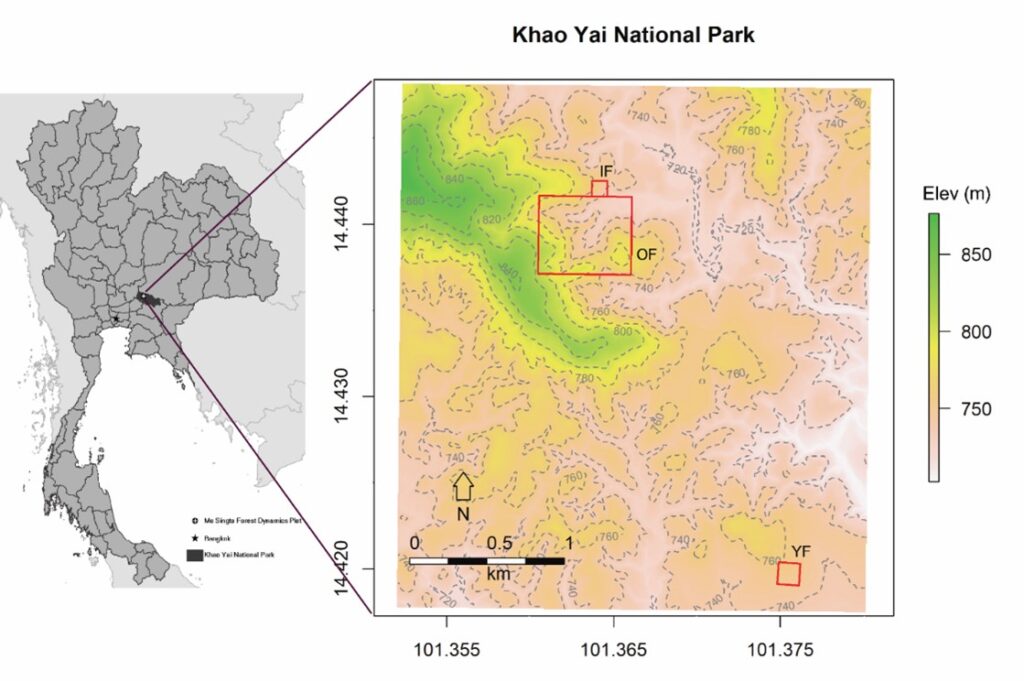
In 2019-2020, we established one tower in each of the sites. In OF, we built a 50-m tall tower in a gap of the Mo Singto plot. In YF, the tower is 20 m tall. Both towers are equipped with standard meteorological sensors as follows (one set per site):
1. Temperature & RH: Temperature/RH probe (EE181-PT, Campbell Scientific)
2. Photosyntheticallly Active Radiation: Quantum sensor (LI190R-PT, Campbell Scientific)
3. Rainfall: Texas Elect. Rain gauge 9.6 in 0.1mm TIP (TE525MM-PT, Campbell Scientific)
4. Wind speed and direction: Metone 034B Wind Set (034B-PT, Campbell Scientific)
5. Soil moisture at 5, 10, 15 and 30 cm depth: Water content reflectometer (CS616-PT-U, Campbell Scientific)
In late 2020, thermal dissipation probes were installed in 10 and 12 trees in OF and YF, respectively, covering the size distribution within the plot. Data from the weather and sap flux sensors are being logged at 30-minute intervals by a data logger (CR1000X, Campbell Scientific) and can be checked and downloaded remotely. Electric fences were also built to prevent large animals, such as wild elephants, from attacking the towers.


Measurement of tree water flow
Our main research technique involves sap flow sensors which are used to track the water use rates in trees. These data indicate the responses of the trees, in terms of physiological processes such as transpiration and photosynthesis, to the changing environmental conditions. We specifically use thermal dissipation probes (Granier-type sap flow sensors) which are customly made, installed and setup for measurements by ourselves. We established the monitoring systems of tree water flow, aiming for long-term measurements, in both forest sites. We selected trees within the 25-m radius from the tower (due to the required specification of the measurement setup) based on tree size distribution of each site. The data will later be used to scale up to canopy transpiration, and, together with an appropriate modeling approach, canopy photosynthesis. In the young forest, tree water flow rates of 12 trees are being monitored. The tree species include Syzygium nervosum, Adinandra integerrima, Cratoxylum cochinchinensis, and Syzygium antisepticum. In the old growth forest, tree water flow rates of 10 trees are being monitored. The tree species include Aquilaria crassna, Cinnamomum subavenium, Syzygium antisepticum, Syzygium syzygoides, Nephelium melliferum, and Altingia excelsa.